
Risk Governance: Why Recognition, Research and Reporting Matter

A discussion piece from DriverFocus
For many Irish employers, driving for work is still the workplace risk that does not quite sit anywhere. It falls between road safety and workplace safety, with accountability split across functions that do not always speak to each other. The harm is not split. It accumulates in the same place every year.
A National Public Health Issue
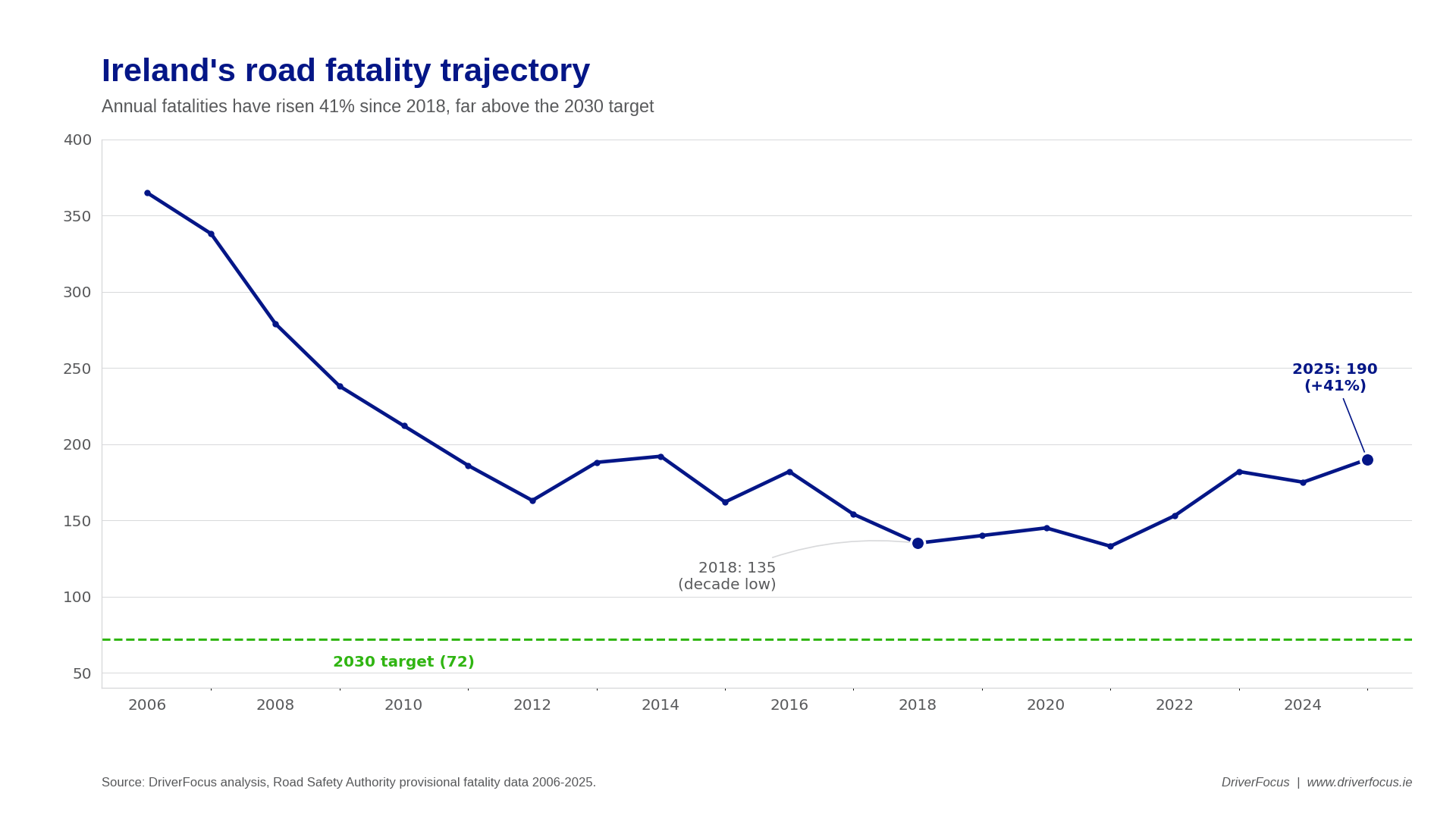
Irish road fatalities have risen sharply over the last decade. RSA provisional data records 190 fatalities in 2025. That is up 41% from 135 in 2018 and the highest annual total in more than ten years.1
Ireland’s fifth government Road Safety Strategy 2021-2030 aims to reduce deaths and serious injuries on Irish roads by 50% by 2030. That implies bringing annual road deaths to 72 or fewer and serious injuries to 630 or fewer. The 2025 trajectory is not on course.
The Irish Times, in a March 2026 opinion piece, framed the rising toll as a public health issue that warrants the response normally reserved for public health emergencies.2
Approximately 29% of Irish road fatalities are categorised as work-related, with one in four drivers in fatal collisions in 2024 driving for work.3
That is the operational context for the Three Rs. Driving for work risk is not a peripheral compliance topic. It is a measurable and rising contribution to a national fatality trend that is moving in the wrong direction.
The Visibility Gap
A conservative estimate suggests that at least 28 people per month in Ireland are killed or seriously injured in incidents involving someone driving for work.4
The pattern is not unique to Ireland. The UK Department for Transport reports that approximately one in three road traffic fatalities in Britain involves someone driving or riding for work.5
Most of those incidents do not appear in traditional workplace safety reporting. They appear in collision statistics, insurance claims and court cases, but rarely in the same governance conversations that cover slips, trips, manual handling or psychosocial risk.
The gap is not caused by a lack of guidance. The Health and Safety Authority, the Road Safety Authority and An Garda Síochána have collaborated on driving for work guidance since 2009, with updated guidance issued in 2025. The Safety, Health and Welfare at Work Act 2005 already requires employers to manage risks arising from work activities, including driving.
The gap is in what gets seen. Many organisations still rely on policy documents, ad hoc declarations and spreadsheets that look credible on a desk but provide limited visibility or auditability after a serious incident.
That gap is now publicly acknowledged. A recent ministerial response confirmed that not all work-related collisions are reported to the Health and Safety Authority and that the underlying data is still being established and reviewed.
The Three Rs
The Three Rs framework is a contribution to the discussion about how accountability could be strengthened across systems that already exist.
Recognition means acknowledging the true scale of work-related road harm and accepting that many serious collisions arise during the working day, in vehicles being used for work purposes, often by employees doing exactly what the business expects of them. Recognition opens the door. It does not finish the work by itself.
Research means refreshing the evidence base on employer preparedness. The last major Irish study in this area was the 2012 RSA, HSA and An Garda Síochána Survey on Employer Driving for Work Management Practices.6 It found that 47% of businesses had no policies or procedures in place for work-related road safety. A further 67% of staff who drive for work had received no training. Work patterns have changed since. Fleet models have changed. Hybrid working, gig and agency drivers, electric and shared vehicles and director-level governance expectations have all shifted in ways the 2012 evidence does not capture.
Useful measurement frameworks now exist that did not in 2012. The Parliamentary Advisory Council for Transport Safety has published a Core Metrics framework for at-work drivers, built around leading indicators (telematics, licence checks, near miss reporting) and lagging indicators expressed per million miles, including a High Potential Vehicle Collision Rate.7 A refreshed Irish evidence base would have credible international reference points to draw on.
Reporting means improving visibility around inspections, enforcement outcomes and case learnings linked to driving for work. Visibility shapes behaviour. At the moment most of the visible cases are private settlements that never travel beyond those directly involved.
The scale of the reporting gap can now be quantified. In Britain in 2024/25, RIDDOR recorded 216 work-related fatal injuries. The Department for Transport recorded 459 road deaths involving someone driving for work in 2024, more than double the RIDDOR figure.8 Under the Reporting of Accidents and Dangerous Occurrences Regulations made under the 2005 Act, the same structural pattern applies in Ireland. Most work-related road deaths sit in RSA statistics rather than HSA work-related fatality counts. The visibility gap is a measurement gap before it is a culture gap.
Why Reporting Matters
One of the more revealing contrasts in organisational risk management is the difference between how workplace road risk and other regulated safety failures are perceived publicly.
Food safety is the most familiar example. Inspection outcomes, closures and prosecutions can become national news within hours. Aviation operates on the same principle. Mandatory occurrence reporting under EU Regulation 376/2014 and public accident investigation reports from the Air Accident Investigation Unit keep the standard visible across the sector. Fire safety follows the same logic. Prohibition notices and enforcement outcomes under the Fire Services Acts are placed on public record. In each domain the reputational and regulatory consequences are immediate and frequently severe. As a result, employers tend to understand both the standard expected of them and the cost of falling short of it.
Many serious driving for work cases follow the opposite pattern. Even where substantial settlements or enforcement actions arise, they are rarely reconnected to the broader governance discussion. Recent Irish cases involving serious workplace road collisions show the human, legal and financial consequences when controls fail, including a reported €1.9 million settlement linked to a work-related road incident.9
This is not an argument for public criticism of named employers. It is an argument for proportionate visibility, so that the lessons travel further than the case files.
“Driving for work is not simply a transport issue. It is a workplace governance issue with public safety consequences.”
A Governance Issue, Not Just a Safety Issue
Driving for work intersects with duty of care, operational risk, insurance exposure, fleet oversight, contractor management and corporate governance. The decisions that shape exposure are made in finance meetings, procurement reviews and HR policies as much as on the road.
Serious collisions involving staff who drive for work affect more than employees. They affect members of the public, families, emergency services and communities. That widens the duty of care beyond the employer-employee relationship and into something closer to a public-facing obligation.
Organisations generally improve what they can measure, supervise and evidence. The reverse is also true.
What Good Looks Like
In organisations that take this seriously, three things tend to be in place.
First, driving for work is treated as a named operational risk with an owner, a budget and a reporting line, rather than a paragraph inside a generic safety policy.
Second, controls are evidenced rather than declared. Driver licence checks, vehicle suitability, journey risk, fatigue management and incident learning are tracked in systems that produce an audit trail, not in spreadsheets that get updated when someone remembers.
Third, the data feeds back into operational and board-level decisions. Claims rates, incident frequency, cost per vehicle and behavioural trends are reviewed alongside other business metrics. The trend over time is what gets reported, not just the activity in the last quarter.
None of this requires new legislation. It requires existing duties to be operationalised in a way that holds up to scrutiny.
A Working Example of an Accountability Mechanism
A useful contemporary example of an accountability mechanism for driving for work is now on the table in Britain. The 2026 UK Road Safety Strategy commits to piloting a National Work-Related Road Safety Charter for organisations that require people to drive or ride for work. Its stated core principles are organisational accountability, evidence-driven road risk policies, demonstrable compliance and governance, with continuous monitoring and review.10 The Charter is voluntary for an initial two-year pilot, with regulatory measures considered if voluntary engagement is insufficient.
Large UK companies and the UK public sector are expected to write the Charter into procurement and supply-chain contracts. Operators that do not sign up risk being cut off from new and renewing UK work streams. Irish exporters into UK supply chains will be drawn into this standard regardless of any Irish policy decision. So will Irish subsidiaries of UK parents.
There is also evidence that voluntary, evidence-led accountability schemes can move real-world performance. Fleets in the Driver and Vehicle Standards Agency’s Earned Recognition scheme record a 1.56% MOT failure rate compared with 4.54% for fleets outside the scheme.11 That is a measurable performance gap between operators who can demonstrate continuous governance and those who cannot.
The point is not which jurisdiction sets the template. The point is that a working accountability mechanism for driving for work is now visible, measurable and commercially live in a market Irish businesses already trade with.
A Practical Opportunity
The opportunity is to strengthen accountability across systems that already exist.
· Recognition would establish a clearer national picture of work-related road harm.
· Research would give policy makers, regulators and employers an updated evidence base to work from.
· Reporting would help organisations understand what poor governance looks like in practice and reinforce the value of maintaining effective controls.
Together, these steps could move driving for work from an under-recognised operational issue to a more mature governance discipline.
The question is not whether guidance exists. It does. The question is whether accountability is sufficiently visible to influence behaviour.
For employers, that means asking whether current systems would genuinely demonstrate oversight of driving for work risk if tested. For regulators and policy makers, it means asking whether current reporting and visibility mechanisms are sufficient to support deterrence, learning and improvement.
The Three Rs are intended as a practical framework to support that discussion.
Appendix: Supporting Evidence
Grouped by theme. Figures are Ireland-specific unless stated otherwise. Numbered references appear at the foot of the document.
1. Scale of work-related road harm in Ireland
Approximately 29% of Irish road fatalities are categorised as work-related (ETSC, 2025). In 2024, one in four drivers involved in fatal collisions in Ireland were driving for work (RSA, 2024). On a conservative basis using 2025 fatality data and the RSA serious-injury-to-fatality multiplier of 7.25, at least 28 people per month in Ireland are killed or seriously injured in incidents involving someone driving for work (DriverFocus estimate, 2026). The UK pattern is steeper, with approximately one in three road traffic fatalities involving someone driving or riding for work (UK Road Safety Strategy, January 2026).
2. The national fatality trend
RSA provisional data records 190 fatalities in 2025. That is up 41% from 135 in 2018 and the highest annual total in more than ten years. Ireland’s fifth government Road Safety Strategy 2021-2030 aims to reduce deaths and serious injuries on Irish roads by 50% by 2030. That implies bringing annual road deaths to 72 or fewer and serious injuries to 630 or fewer. The 2025 trajectory is not on course. The Irish Times, in a March 2026 opinion piece by Sinéad O’Sullivan, framed the rising toll as a public health issue.
3. The reporting and visibility gap
The Scottish Occupational Road Safety Alliance estimates that if work-fatality statistics captured road deaths involving driving for work, the official figure would be almost three times as high (ScORSA Best Practice Guide, RoSPA, 2026, p.6). In Britain in 2024/25, RIDDOR recorded 216 work-related fatal injuries (124 workers, 92 public) against 459 Department for Transport road deaths involving someone driving for work, more than double the RIDDOR total (Driving for Better Business, sourcing HSE and DfT, 2026). When the DfT figure is compared against RIDDOR worker fatalities alone, the ratio rises to roughly 3.7 times. The same structural pattern applies under Irish reporting, where most work-related road deaths sit in RSA collision data rather than HSA workplace fatality counts.
4. Irish employer preparedness (2012 baseline, not refreshed)
The last national study found 47% of employers had no driving for work policies or procedures, 67% of staff who drive for work had received no training, only 17% conducted risk assessments for driving and just 3% had any crash data analysis process. At 73% and 68% respectively, Leisure and Professional Business Services sectors were the two weakest sectors with no policy in place (RSA, HSA and An Garda Síochána, 2012).
5. Driver behaviour under work pressure (2025 evidence)
Among Irish HGV drivers, 33% report using a hand-held phone for work while driving and 31% feel required by their employer to answer calls without a hands-free option. Only 46% have read their employer’s driving for work policy and 36% do not know if one exists (RSA Driving for Work Seminar, November 2025). Van drivers are approximately twice as likely as other motorists to use a hand-held phone (ETSC, citing RSA, 2025).
6. Employer preparedness in the UK (current)
Even with explicit recognition at strategic level, only 58.3% of more than 400 UK health and safety professionals surveyed in 2025 reported having a comprehensive road risk policy in place, with 26.1% having none and 15.6% in development (Driving for Better Business survey, 2026).
7. The cost of failure
A 2026 Irish case saw a €1.9 million settlement for a cash-in-transit driver who suffered a brain injury in a work-related road collision (Irish Times, 13 March 2026). The largest court fine for a Drivers’ Hours breach in the last five years was €25,000 (RSA, 2026). An Garda Síochána seized 19,600 uninsured vehicles in 2026, against an estimated grey fleet population of around 750,000 vehicles operating in Ireland.
8. A working accountability mechanism: the UK example
The 2026 UK Road Safety Strategy commits to piloting a National Work-Related Road Safety Charter, built on organisational accountability, evidence-driven policies, demonstrable governance and continuous review. Large UK employers and the UK public sector are expected to write the Charter into procurement, drawing Irish exporters and Irish subsidiaries of UK parents into the standard. Fleets in the DVSA Earned Recognition scheme record a 1.56% MOT failure rate against 4.54% for fleets outside the scheme, evidence that voluntary accountability moves real-world performance (Fleet News Safety Report, 2026, p.7).
References
1. DriverFocus analysis, Road Safety Authority, fatality data 2006 to 2025 (provisional); rise of 41% from 135 fatalities (2018) to 190 fatalities (2025). RSA Provisional Reviews. https://www.rsa.ie
2. Sinéad O’Sullivan, “When will we declare Ireland’s road death toll the public health crisis it is?”, The Irish Times, 9 March 2026.
3. European Transport Safety Council, PIN Flash 49 (2025): 29% of Irish road fatalities categorised as work-related. RSA news release, 14 November 2024: one in four drivers involved in fatal collisions in Ireland were driving for work.
4. DriverFocus estimate, 2026, based on RSA 2025 fatality data, the ETSC 29% work-related share and the RSA serious-injury-to-fatality multiplier of 7.25 (RSA driver spotlight report, fatalities and serious injuries 2019 to 2023).
5. UK Road Safety Strategy, January 2026, p.22.
6. Road Safety Authority, Health and Safety Authority and An Garda Síochána, Survey on Employer Driving for Work Management Practices, August 2012. N=500 Irish businesses.
7. Parliamentary Advisory Council for Transport Safety (PACTS), Company Metrics Report, 2026.
8. Driving for Better Business, 2026, sourcing HSE RIDDOR data 2024/25 and UK Department for Transport road deaths involving driving for work, 2024.
9. Irish Times, “Cash-in-transit driver who suffered brain injury in crash settles case for €1.9m”, 13 March 2026.
10. UK Road Safety Strategy, January 2026, p.21 to 22; Fleet News Safety Report, 2026, p.7.
11. Fleet News Safety Report, 2026, p.7 (DVSA Earned Recognition scheme).