

Business kilometres decide two things on every company payroll. They set the BIK charge on each company car and they decide whether mileage payments stay tax-free. When the records behind those kilometres do not hold up, Revenue looks to the employer, not the driver. Here is what that costs in 2026 and how to close the gap before anyone asks.
Two exposures, one root cause
Company car BIK. The BIK charge on a company car depends on its original market value and on documented business kilometres. If business mileage is overstated or not evidenced, notional pay has been under-taxed on every payslip. Revenue's guidance is clear that the "total mileage less 8,000 km private" shortcut is not a planning tool: it applies only where there is not sufficient evidence to the contrary. The onus to keep records sits with the employer (Revenue, Tax and Duty Manual Part 05-01-01b (https://www.revenue.ie/en/tax-professionals/tdm/income-tax-capital-gains-tax-corporation-tax/part-05/05-01-01b.pdf)).
Mileage reimbursement. Payments at or below civil service rates are tax-free only for genuine, documented business journeys. Rounded-up claims, reconstructed logs and reimbursed commuting can be treated as pay.
Both exposures come back to the same question: can the organisation show, journey by journey, that the kilometres were business kilometres?
What a failed record costs
Where tax-free payments are recharacterised as pay, the employer pays the tax the employee should have paid, grossed up. On our worked example for a higher rate employee, every €1,000 paid tax-free without evidence costs the employer about €2,309 once PAYE, PRSI and USC are grossed up.
On top of the tax sit three further costs:
· Fixed penalties of up to €4,000 per incorrect return. With monthly payroll submissions, that can reach €48,000 in a single year.
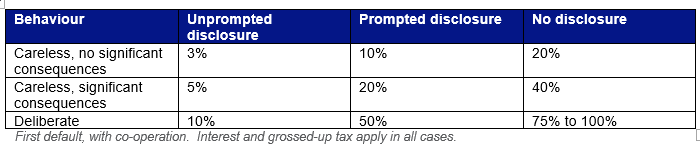
· Tax-geared penalties of 3% to 100% of the tax due, depending on behaviour and disclosure, under Revenue's Code of Practice for Revenue Compliance Interventions.
· Statutory interest, charged daily and rarely waived, at roughly 8% a year across a four-year look-back.
Why 2025 changed the odds
Since 1 January 2025, Enhanced Reporting Requirements (ERR) oblige employers to report travel and subsistence payments, including mileage, to Revenue on or before the date each payment is made. Revenue now sees mileage payments in close to real time, alongside the BIK reported through payroll. A pattern that once only surfaced at audit can now be profiled from the data Revenue already holds.
Timing matters too. Once a Level 2 intervention such as an audit is notified, the unprompted disclosure route closes and the minimum penalty for careless behaviour rises from 3% to 10% (or from 5% to 20% where the consequences are significant).
Five steps that close the gap
1. Capture. Log every business journey as it happens, with GPS verification where possible. No reconstruction at year end and no round numbers.
2. Policy. A written travel policy that separates business from private use, excludes commuting and sets rates at or below civil service levels.
3. Review. A quarterly check of verified business kilometres against the BIK band applied in payroll.
4. Report. ERR returns filed on or before each payment date and reconciled to payroll and mileage data.
5. Disclose. If a review finds an error, an unprompted qualifying disclosure carries the lowest penalty and keeps the matter off the published defaulters list.
None of this is complicated. Most of it is about doing the recording at the time rather than rebuilding it later, which is also where the admin time goes.
This article is general information, not tax or legal advice. Check your own position against current Revenue guidance or with your tax adviser. Our Company Car BIK Guide 2026 and EV BIK 2026 to 2029 set out the rates and reliefs in more detail.
DriverFocus helps Irish employers capture business mileage that holds up when it is questioned.
Book a call (https://www.driverfocus.ie/contact)
Sources
• Revenue, Tax and Duty Manual Part 05-01-01b, Benefit in kind on employer provided vehicles: https://www.revenue.ie/en/tax-professionals/tdm/income-tax-capital-gains-tax-corporation-tax/part-05/05-01-01b.pdf
• Revenue, Tax and Duty Manual Part 38-03-33, Enhanced Reporting Requirements
• Revenue, Code of Practice for Revenue Compliance Interventions
• Revenue, Enhanced Reporting Requirements for employers: https://www.revenue.ie/en/employing-people/enhanced-reporting-requirements/index.aspx
• DriverFocus, Be Audit Ready: Company Car / EV BIK Tax Guide 2026: https://www.driverfocus.ie/blogs/bik-2026