
How many people died at work on Irish roads in 2025? It sounds like a question with an answer. It is not. On 21 October the IOSH Ireland Community hosted a webinar, "Workplace Road Risk: Bridging the Gaps", for 111 health and safety practitioners. That question opened it. The national picture has a gap in it. The same gap shows up inside most organisations…
Three State figures, three different things
The State holds several figures for 2025 and none of them is published alongside the others.
· 182 people died on Irish public roads (Road Safety Authority, provisional as at September 2026).
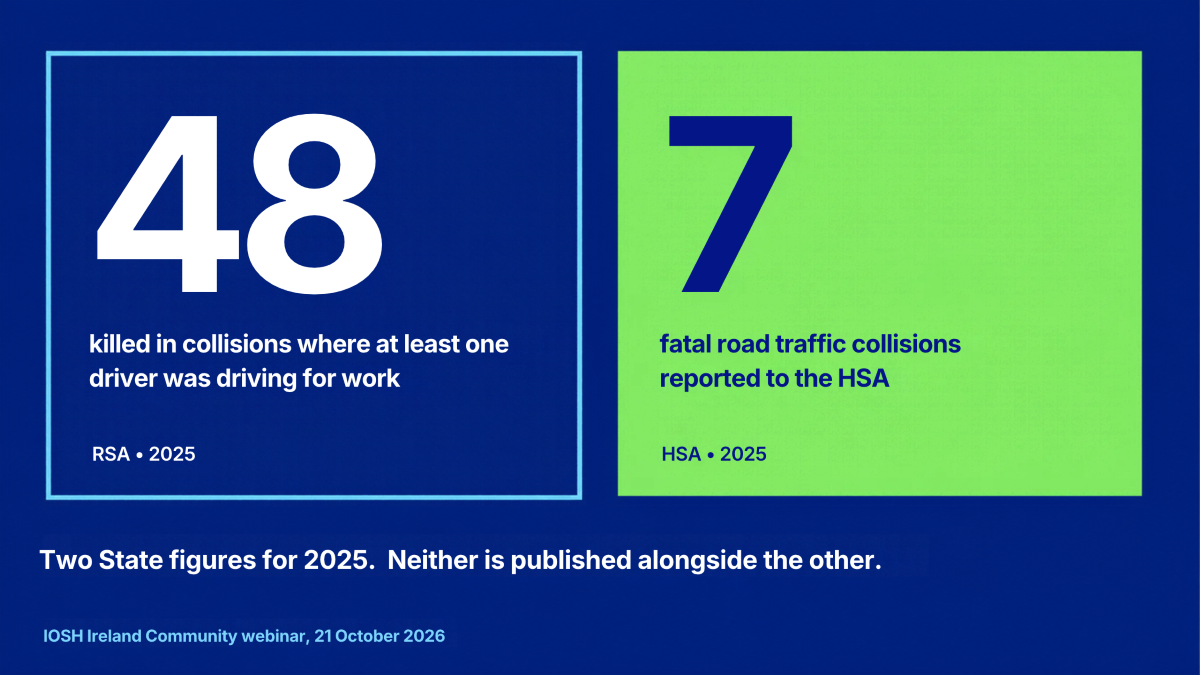
· 48 of them were killed in a collision where at least one driver involved was driving for work, about one in four (RSA, provisional, as presented at the webinar).
· 7 fatal road traffic collisions were reported to the Health and Safety Authority (written answer to a Dáil question, 17 September 2026).
The 48 counts people and the 7 counts collisions, so they cannot be set against each other directly. That is the point. Without a shared case identifier, nobody can say how far the two overlap.
The gap is structural and it is nobody's failure. Each agency counts what its own remit requires and both datasets are accurate for the purpose they were built for.
The 48 also carries a second lesson. Occupational risk is usually understood as risk to the worker. Work-related road risk is different, because a large share of the people it kills are not workers at all: other drivers, passengers, pedestrians and cyclists.
The same gap inside your organisation
Look at where driving for work lives in a typical organisation. Collisions sit in the insurance file. Licences sit with fleet or admin. Business journeys sit in expenses or payroll. Absence and injury sit in HR. Risk assessments sit with health and safety. Every one of those systems can be accurate and the governance picture can still be wrong, because nothing joins them.
Before the webinar, IOSH polled registered members (50 responses, 2 to 16 October 2026; self-selected, not a national sample). A lot has moved since the last national survey of Irish employers in 2012, when 47% had no driving for work policy and 3% analysed their own crash data.
· 64% now have a written driving for work policy that has been communicated.
· 80% were confident a minor road collision would reach health and safety.
· 24% could say, from a single source, who drove for work for them last month and what checks apply to each.
· 36% cover private vehicles used for work the same way as company vehicles.
· 36% have no single owner for road risk.
· 32% had not heard of the 2025 RSA, HSA and An Garda Síochána driving for work guidance until the poll asked.
Policy is in place. Evidence is not. Confidence runs ahead of the data, much as it does nationally.
IOSH asks the HSA to publish the figures
Fabian Murphy CFIOSH, who co-presented the session, closed it on behalf of the IOSH Ireland Community with a call on the HSA to publish its work-related road fatality figures in its annual report. Once the number is published, boards can ask about it.
The wider picture is already moving. The joint driving for work guidance arrived in July 2025. In July 2026 the HSA began a nationwide inspection campaign (https://www.hsa.ie/eng/news_events_media/news/press_releases_2026/health-and-safety-authority-targets-driving-for-work-risk-management-in-nationwide-inspection-campaign/) against it, covering company and private vehicles alike. What employers were asked to read last summer is what they are being asked to produce this year.
Three things to do this month
1. Count people, not vehicles. Pull twelve months of mileage claimants from expenses and compare that list with the fleet list. The difference is the part of your driving population nobody owns.
2. Trace one incident. Take a road incident from the past year. Did it reach health and safety? Was anyone outside the organisation affected and was that recorded? Did anything change for that driver afterwards? Where the trail breaks is your reporting gap.
3. Score yourself against the six steps in the 2025 guidance. Mark each one evidenced (it would survive being tested), declared (it exists on paper) or absent. An hour with whoever owns fleet and whoever owns expenses will get you most of the way.
Most organisations are strong on declared and thin on evidenced. So, for now, is the country.
Our Fleet Safety Action Plan Template 2026 (https://www.driverfocus.ie/resources-list/fleetsafetyactionplan2026) is a practical place to record your scores and next steps.
DriverFocus works with Irish employers to join up the driver, vehicle and journey data that turns a declared policy into evidence.
Book a call with us to find out more
Sources
· RSA Research Department, 2025 road fatality and trip-purpose data, September 2026, provisional, as presented at the IOSH Ireland Community webinar, 21 October 2026
· Minister of State, Department of Enterprise, Tourism and Employment, written answer, 17 September 2026 (fatal road traffic collisions reported to the HSA: 7 in 2025)
· IOSH Ireland Community, Workplace Road Risk: Bridging the Gaps, pre-event poll of members, 16 October 2026, 50 responses
· RSA, HSA and An Garda Síochána, Survey on Employer Driving for Work Management Practices, August 2012, 500 businesses
· RSA, HSA and An Garda Síochána, Driving for Work: Risk Management Guidance for Employers, July 2025: https://www.drivingforwork.ie
· HSA, Health and Safety Authority targets driving for work risk management in nationwide inspection campaign, 7 July 2026: https://www.hsa.ie/eng/news_events_media/news/press_releases_2026/health-and-safety-authority-targets-driving-for-work-risk-management-in-nationwide-inspection-campaign/