
RSA and HSA DFW - May 2026 Seminar
What Fleet Managers Need to Know from the 2026 Driving for Work Seminar
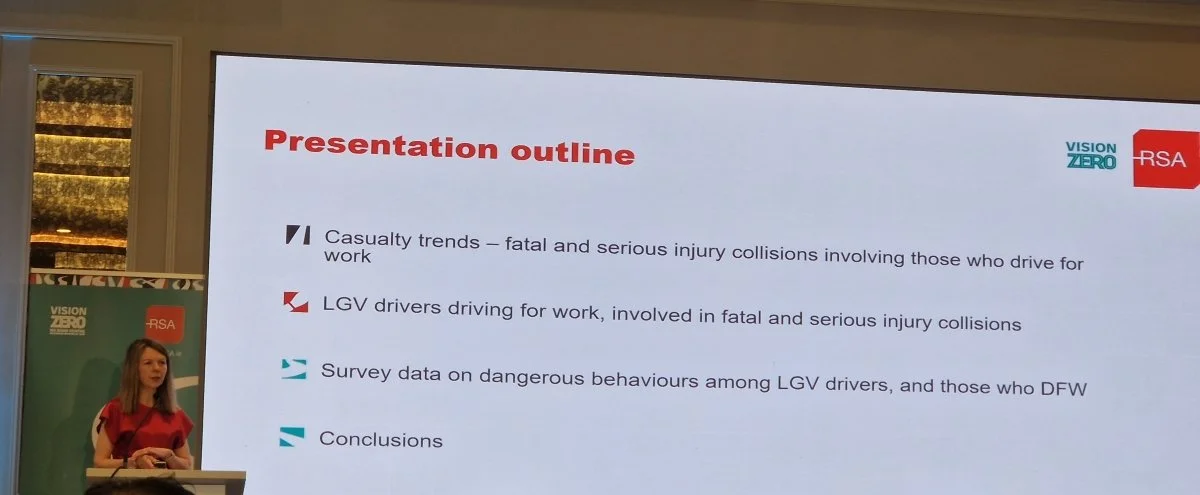
On 20 May 2026, the RSA convened its annual Driving for Work Seminar at Johnstown Estate in Enfield. Speakers from the RSA, HSA, An Garda Síochána - Sgt. Tony Miniter’s presentation was a favourite of the day among many attendees - as well as the ETSC, ESB Networks, Egis and Driving for Better Business, set out the current state of van and car fleet safety in Ireland and across Europe.
For fleet managers, the picture that emerged is worth paying attention to.
Van compliance is getting worse, not better
The RSA's roadside compliance rate for light commercial vehicles (LCVs) fell to 45% in 2026 year-to-date, down from 51% in 2025. Only 64% of LCVs pass their CVRT at the first attempt, compared to 74% for heavy commercial vehicles. The most common defects are tyres, stop lamps and lighting failures. Inspectors described drivers clearing cracked windscreens with a cloth rather than replacing them.
The legal position is unambiguous. Vehicle owners face fines of up to €5,000 and potential imprisonment for non-compliance. Roadside checks can result in impoundment. The compliance obligation sits with the operator, not the driver.
Van drivers are the highest-risk group on Irish roads
RSA data covering 2021 to 2025 shows that 28% of all road fatalities in Ireland involved at least one driving-for-work driver. Light goods vehicles (LGVs) account for 10% of vehicles in fatal collisions despite making up a fraction of total traffic.
The behavioural picture is equally stark. An RSA observational survey in late 2025 found that 15% of LGV drivers were using a mobile phone while driving: the highest rate of any vehicle type and up from 2% in 2024. Four in ten driving-for-work drivers exceeded a 50km/h limit by more than 10km/h, against 27% of all motorists. Nearly half reported feeling pressure from their employer or work schedule to engage in at least one unsafe behaviour.
These are not random incidents. They reflect how work is organised.
The employer duty of care is not optional
The HSA drew on the Driver, Vehicle and Journey framework from its Driving for Work Risk Management Guidance, published in July 2025. A vehicle is a place of work under the Safety, Health and Welfare at Work Act 2005, which means the same risk management obligations that apply on your premises apply on the road. Driver licence checks, fitness to drive, fatigue management, vehicle selection criteria, pre-use checks and journey scheduling all fall within that scope.
The gap between knowing this and acting on it remains large. Mark Cartwright of Driving for Better Business, presenting research from the UK, was direct: there is a significant distance between awareness of a risk and active management of it. Policy documents alone do not close that gap.
New vehicle technology is changing the compliance baseline
From 7 July 2026, all newly manufactured vehicles must include Advanced Driver Distraction Warning (ADDW) systems under EU General Safety Regulation 2019/2144. This follows the mandatory introduction of Advanced Emergency Braking, Intelligent Speed Assistance and Driver Drowsiness Warning systems for new vehicles from July 2024. EuroNCAP is also revising its star rating methodology in 2026: vehicles with touchscreen-heavy controls will score lower; those with physical switches will score higher, in recognition of the distraction risk they present.
Fleet managers replacing vehicles in the next 12 to 24 months should factor these changes into procurement decisions. Vehicles pre-dating the General Safety Regulation will not carry these protections.
There is also a regulatory deadline immediately ahead. LCVs over 2.5 tonnes engaged in international transport must be retrofitted with a smart tachograph by 1 July 2026. Operators in scope who have not already acted should treat this as urgent.
What the gap between 64% and 97% tells you
ESB Networks presented its fleet safety approach to the seminar. Its yellow fleet covered over 40 million kilometres in 2025. Its first-time CVRT pass rate was 97%, against the national LCV average of 64%. ESB operates a structured telematics monitoring and escalation process: monthly data review, safety conversations for first offences, formal intervention and external training for repeat instances, and potential stand-down for persistent breaches. Its Road Safety Action Plan 2026-2030 covers 36 actions across four pillars.
The 33-percentage-point gap between ESB's pass rate and the national average is not accidental. It is the product of a system.
The seminar confirmed that regulatory attention on van and car fleets is increasing. The RSA, HSA and AGS are aligned on enforcement priorities. The statistics on mobile phone use, speeding and driver fatigue point to employer behaviour as a primary lever, not a secondary one.
If your driving for work programme is overdue a review, DriverFocus works with Irish car and van fleet operators to build the systems and driver oversight that produce measurable results. Book a call to find out where your fleet stands. You can also watch back the entire seminar via this link.
Related DriverFocus Reading:
Van Drivers and Mobile Phone Use - RSA Study Findings (April 2026) - directly tied to the RSA observational data cited in the seminar (van drivers more than twice as likely to be on their phones).
Are Your Work Vehicles Really Safe? (October 2025) - covers NCT/CVRT failure rates and vehicle maintenance obligations.
Are Your Vans Delivering Safely? (March 2021) - focused on gig economy drivers and last-mile delivery risk.